Word Scramble Generator Guide: How to Create Jumble Puzzles Fast
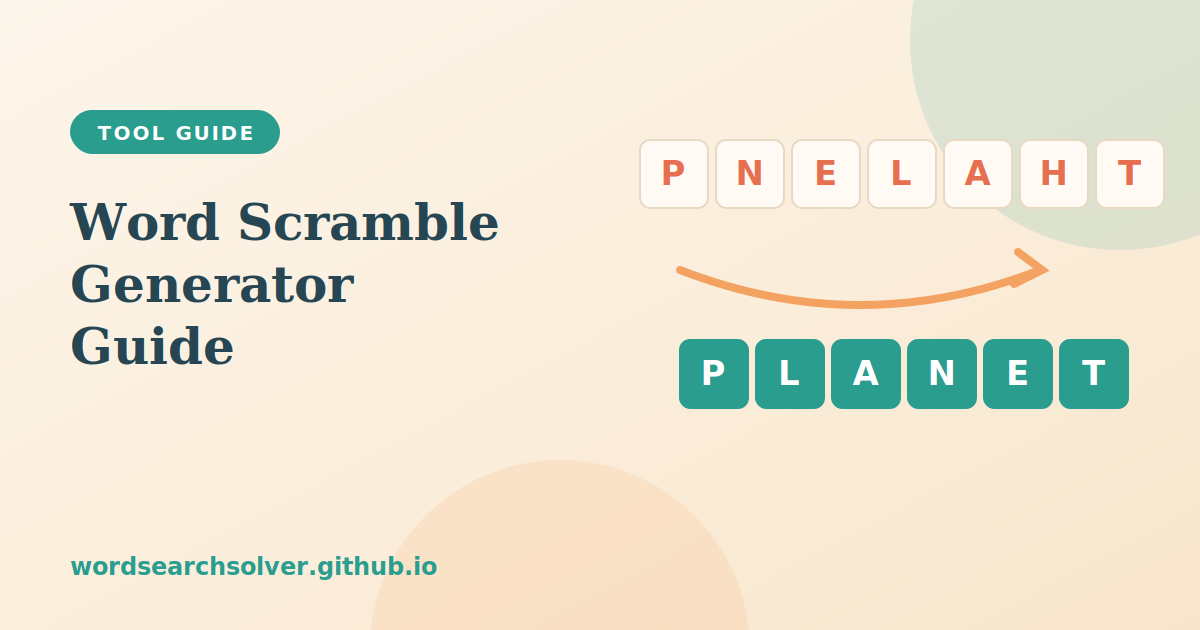
A word scramble, also called a jumble, is one of the simplest puzzles to understand and one of the most effective for practising spelling. You are given a word with its letters mixed up, and you put them back in order. The format works for six-year-olds learning to read and for adults who want a quick brain warm-up.
Making a good scramble by hand is surprisingly fiddly, because a careless shuffle can leave a word unchanged or scramble it so thoroughly that it is unfair. The Word Scramble Generator handles the shuffling and keeps the puzzle fair. This guide explains how it works, how to choose difficulty, and how to use scrambles in classrooms, at home and at events.
What Is a Word Scramble?
A word scramble takes a word, rearranges its letters at random and asks the solver to recover the original. CLOUD might become LUDOC. The solver uses knowledge of common letter patterns, such as the fact that CL is a typical start and OU a typical pair, to rebuild the word.
The puzzle works because it exercises several skills at once. Solvers must recall vocabulary, recognise spelling patterns and test possibilities mentally. That combination makes scrambles popular in classrooms, newspapers and family activity books.
How the Word Scramble Generator Works
The generator takes your list of words, shuffles the letters of each word and presents the results as numbered puzzle items. Each item shows the length of the original word so that solvers know how many letters to expect. This small detail makes puzzles fairer and more satisfying.
You can type your own words or load words from the built-in word list when you need a quick puzzle. A balanced puzzle usually has eight to twelve words, enough to feel substantial without becoming overwhelming.
Once generated, you can show or hide the answers with a single toggle. The print version always hides them, so you get a clean puzzle sheet you can hand to students or guests.
Step-by-Step: Make Your First Jumble
- Open the Word Scramble Generator.
- Type your words into the box, one per line or separated by commas, or load the built-in list.
- Choose a difficulty level: easy, medium or hard.
- Press the generate button to create your scramble.
- Use the answer toggle to check every word, especially if you typed unusual spellings.
- Print a clean copy of the puzzle, with answers hidden, and keep the answer view for yourself.
Choosing a Difficulty Level
The three levels change how much help the solver gets.
| Level | How letters are scrambled | Best for |
|---|---|---|
| Easy | First and last letters stay in place, and the middle is shuffled | Young children and beginners |
| Medium | All letters are shuffled, but never back into the original word | Most students and families |
| Hard | Letters are completely scrambled | Adults, puzzle clubs and long words |
On easy mode, ELEPHANT might appear as E _ _ _ _ _ _ T with the middle letters mixed up, giving solvers an anchor at each end. Medium and hard remove that anchor, so solvers must work out the word from all the letters. A good strategy for mixed groups is to generate the same list at two levels and let each person choose.
Choosing Words That Make a Great Scramble
As with any puzzle, the word list matters more than any setting.
- Pick a theme. Spelling lists, science terms, historical figures, book characters or holiday vocabulary all work well.
- Mix lengths. Use short words of three or four letters for quick wins and longer words of seven to ten letters for challenge.
- Avoid words with repeated letters if the audience is young. Words like BANANA are difficult to unscramble because the repeated letters make the rearrangements less distinctive.
- Check spellings. The answer will show exactly what you typed, so misspellings will appear in the key.
- Aim for eight to twelve words. Fewer feels thin, and more feels like a chore.
If you need ideas, the Random Word Generator can generate themed lists, and the Random Word Generator guide explains filters that produce words of exactly the length you need.
Using Scrambles in the Classroom
Teachers have used jumbles for decades because they require almost no preparation and fit into any subject. Here are some formats that work well.
- Bell-ringer. Put five scrambled vocabulary words on the board as students arrive. They settle quickly and start thinking about the day's topic.
- Early finisher activity. Keep a printed scramble in a folder for students who finish a task early.
- Review game. Divide the class into teams and race to unscramble a list of key terms before an exam.
- Spelling practice. Convert the weekly spelling list into a scramble. Students must actively recall the letters, which is more effective than copying words out.
- Language learning. Use scrambles in a second language to practise spelling and vocabulary recall.
For mixed-ability groups, hand out the same scramble at different difficulty levels. Everyone works on the same words, so the group can share answers afterwards.
Ideas for Home, Parties and Care Settings
Scrambles are easy to adapt outside school. Parents can build one from the names of family members or favourite animals and print it for car trips. Party hosts can scramble guest names, event keywords or movie titles and hand out sheets as an ice-breaker. Caregivers and therapists often use scrambles as gentle cognitive exercises because they are quiet, short and can be done at the solver's own pace.
For themed events, keep the word list short and the difficulty at medium. People enjoy a puzzle they can finish, and an unfinished one tends to be abandoned.
How to Solve Scrambled Words Faster
If you are on the solving side, a few techniques help a great deal. First, look for common letter pairs and endings such as TH, SH, CH, ING, ED and ER, and set them aside as chunks. Second, find the vowels and try them between different consonants. Third, write the letters in a circle rather than a line, which breaks the habit of reading them in the order they appear. Finally, try placing likely first letters, such as consonant blends like ST, TR or PL, and see whether the rest falls into place.
If you are stuck, the Anagram Solver guide shows how to use a solver to find every word that can be made from a set of letters. It is a quick way to check an answer, and a useful learning aid once you have tried it by hand.
To turn the same word list into a different style of puzzle, try the Word Search Generator and read the Word Search Generator guide. Using the same words in several formats is a proven way to help learners remember them.
Frequently Asked Questions
What does easy mode do?
Easy mode keeps the first and last letters in place and shuffles the middle, which gives solvers a helpful anchor.
How many words should a scramble have?
Between eight and twelve words works well for most audiences.
Can I see the answers?
Yes. Use the answer toggle to show or hide each solution. The print version hides them automatically.
Does it show the length of each word?
Yes. Each scrambled word shows its length so solvers know how many letters to expect.
Can I print the puzzle?
Yes. The print output is a clean, ink-friendly sheet with the answers hidden.