Anagram Solver Guide: How to Unscramble Letters Into Winning Words
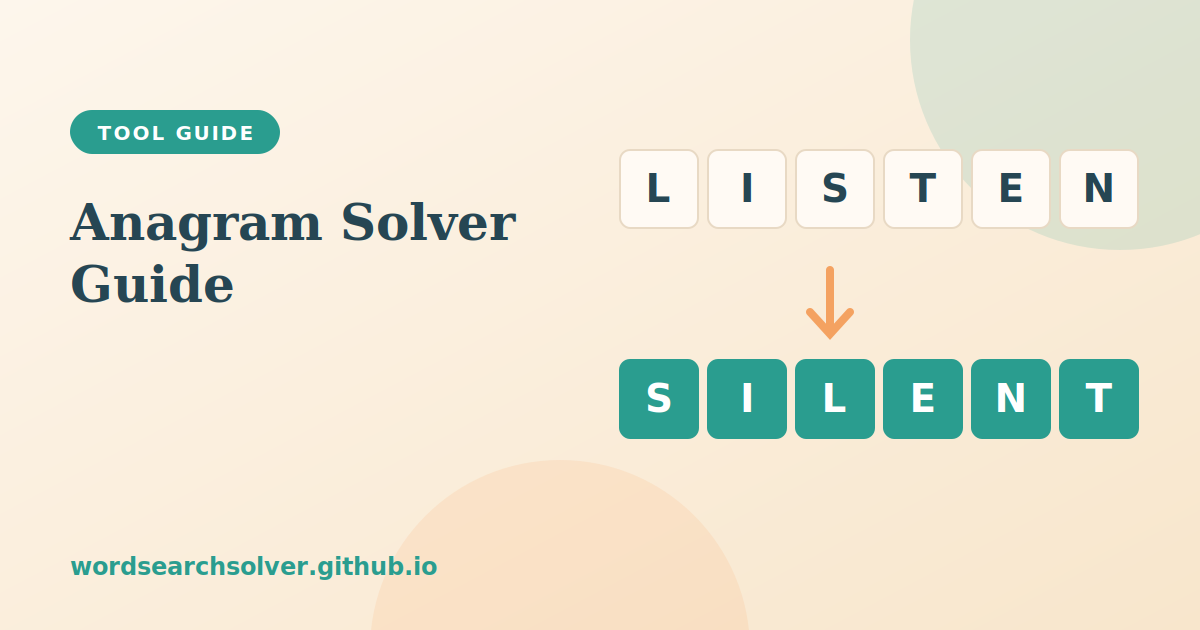
An anagram is a word or phrase formed by rearranging the letters of another. LISTEN becomes SILENT, and EVIL becomes LIVE. The idea is old, but it powers some of the most popular word games in the world, from Scrabble racks to newspaper jumbles. When the right arrangement will not come to you, an anagram solver can find it in a moment.
This guide explains how the Anagram Solver works, the difference between exact and sub-anagram modes, how to use the length filter and sorting options, and how to turn the results into better scores and sharper instincts.
What Is an Anagram?
In the strictest sense, an anagram uses every letter of the original exactly once. NIGHT and THING are perfect anagrams of one another, because they share exactly the same five letters. The word comes from the Greek for re-writing, and writers have used anagrams for centuries as pen names, riddles and hidden messages.
In word games, the idea is stretched. A Scrabble player with a rack of seven tiles rarely has a perfect anagram available. What they need is any valid word that uses some of their letters, ideally the most valuable ones. That is where the second mode of the solver comes in.
How the Anagram Solver Works
The solver uses letter-frequency matching. When you enter your letters, it counts how many times each letter appears. Then it compares that count against every word in its dictionary. A word is a valid result only if it does not need more of any letter than you provided.
This approach is fast because it never tries to rearrange the letters. Instead of generating every possible arrangement, which grows astronomically as the word gets longer, it simply checks each dictionary word against your letter counts. Even with a large word list, results appear almost instantly.
You can enter up to fifteen letters. The tool converts them to upper case automatically, so you do not need to worry about how you type them.
Exact Anagram Mode vs Sub-Anagram Mode
The most important choice you make is the mode. Each answers a different question.
| Mode | What it finds | Best used for |
|---|---|---|
| Exact anagrams | Words that use every letter you entered | Jumbles, anagram clues, bingos in Scrabble |
| Sub-anagrams | Words that use some or all of your letters | Scrabble and Words With Friends racks |
For example, suppose you enter the letters T, I, N, S, E and L. Exact mode will show words that use all six letters, such as LISTEN, SILENT, ENLIST and TINSEL. Sub-anagram mode adds all the smaller words, such as TIN, NEST, SILT, LINT and LIES, because they use only some of the letters.
Start with exact mode when you suspect the answer uses every letter, as in a jumble puzzle or a cryptic clue. Switch to sub-anagram mode when you want the best available word from a limited set of tiles.
Length Filter and Sorting: Getting the Results You Need
A sub-anagram search on seven letters can return a long list, so two features help you cut it down.
Length filter
Choose an exact word length and the list shows only words of that size. This is perfect when a puzzle tells you how many letters the answer has, or when you are looking for a specific kind of play, such as a five-letter word that fits a gap on the board.
Sort options
Sort by longest first when you want the highest-scoring words, by shortest first when you need a quick play, or alphabetically when you want to scan the list methodically. Results are grouped by length so that you can see at a glance how many options exist at each size.
Click any result to copy it, or use the copy-all button to take the full list to a notes app or a message to a friend.
Scrabble and Word Game Strategies
An anagram solver is useful in any rack-based game, but it works best when you pair it with strategy. These principles apply to Scrabble, Words With Friends and similar games.
- Look for bingos first. In Scrabble, using all seven tiles in one turn earns a 50-point bonus. Run exact mode on your seven letters before looking at shorter plays.
- Value tiles, not just length. A short word that uses a high-value letter on a premium square can beat a longer word of common letters.
- Keep a balanced rack. Playing off several consonants and keeping a mix of vowels improves your next draw.
- Learn common endings. Words ending in -ING, -ED, -ER, -LY and -TION appear constantly. If your rack contains those letters, try building around them.
- Use the solver for learning, not just winning. Review the words you missed after a game. Over time you will start to see them without help.
Checking a solver during a competitive game may break the rules, so keep it for practice, casual play and settling friendly disputes. It is also an excellent way to prepare before a match.
Solving Anagram Clues in Crosswords
Many crossword clues include an indicator word that tells you the answer is a rearrangement of letters. Words such as mixed, confused, broken, arranged, scrambled and rebuilt are common signals. When you spot one, the clue usually contains the letters you need, either as a word in the clue or as a short phrase.
Copy those letters into the solver in exact mode, add the answer length as a filter, and you will usually have a short list of candidates. Compare each with the rest of the clue to find the one that makes sense. If you want to go further, the Crossword Solver guide covers pattern-based searching for the remaining squares.
Using Anagrams to Learn and Create
Anagram play is not only for competition. Teachers use it to explore how letters combine into words and why spelling patterns repeat. Writers use it to find punchy names, titles and hidden meanings. Puzzle fans use it to keep their minds sharp.
A good exercise is to take a long word and see how many shorter words you can find inside it. Pick a word such as PLANETARIUM and challenge yourself to find ten words from its letters before you use the solver. Then compare your list with the tool's results to see what you missed.
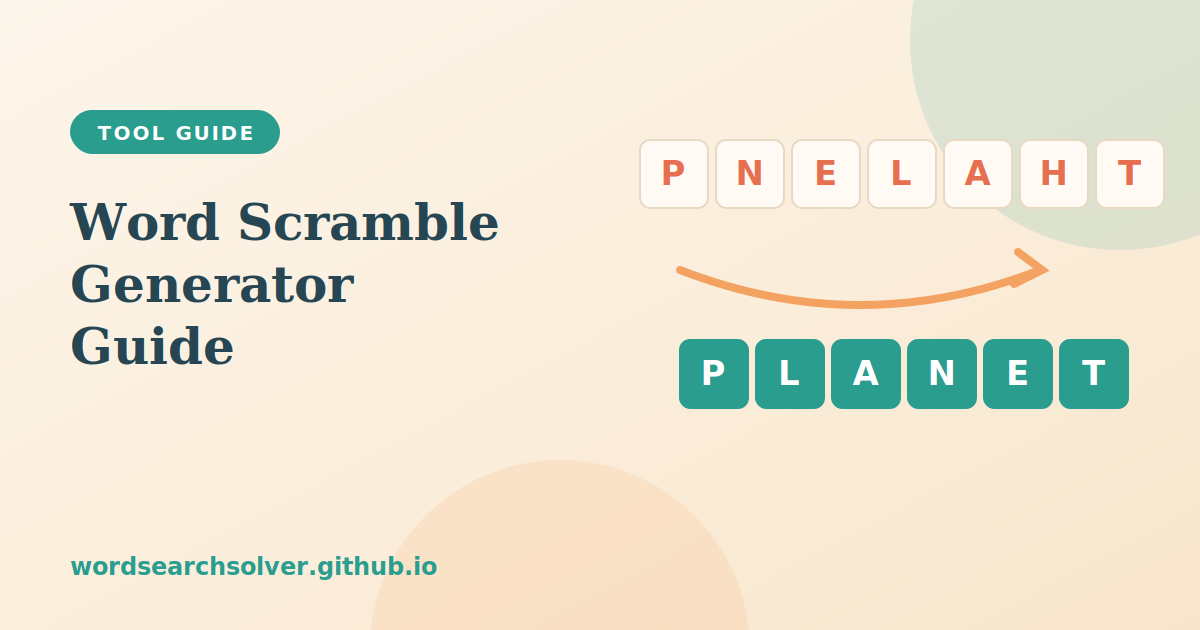
If you want to turn this into a printable activity, the Word Scramble Generator guide explains how to scramble your own word lists into puzzles, and the Word Scramble Generator will do the work for you.
Frequently Asked Questions
What is the difference between an anagram and a sub-anagram?
An anagram uses every letter once. A sub-anagram is a word made from some of the letters, which is how most word-game plays work.
How many letters can I enter?
You can enter up to fifteen letters in one search.
Can I filter by word length?
Yes. Pick a length to see only words of that exact size, which is ideal when a puzzle tells you how long the answer is.
Does it help with Scrabble and Words With Friends?
Yes. Use sub-anagram mode on your rack and sort by longest first to find high-scoring plays.
Is the anagram solver free?
Yes. It is free to use, needs no account and works on any device.