Crossword Solver Guide: How to Crack Any Clue With Letter Patterns
Every crossword fan knows the feeling. The grid is nearly full, you have three of the seven letters you need, and the clue might as well be written in another language. You could stare at it for another ten minutes, or you could let a pattern solver do the heavy lifting.
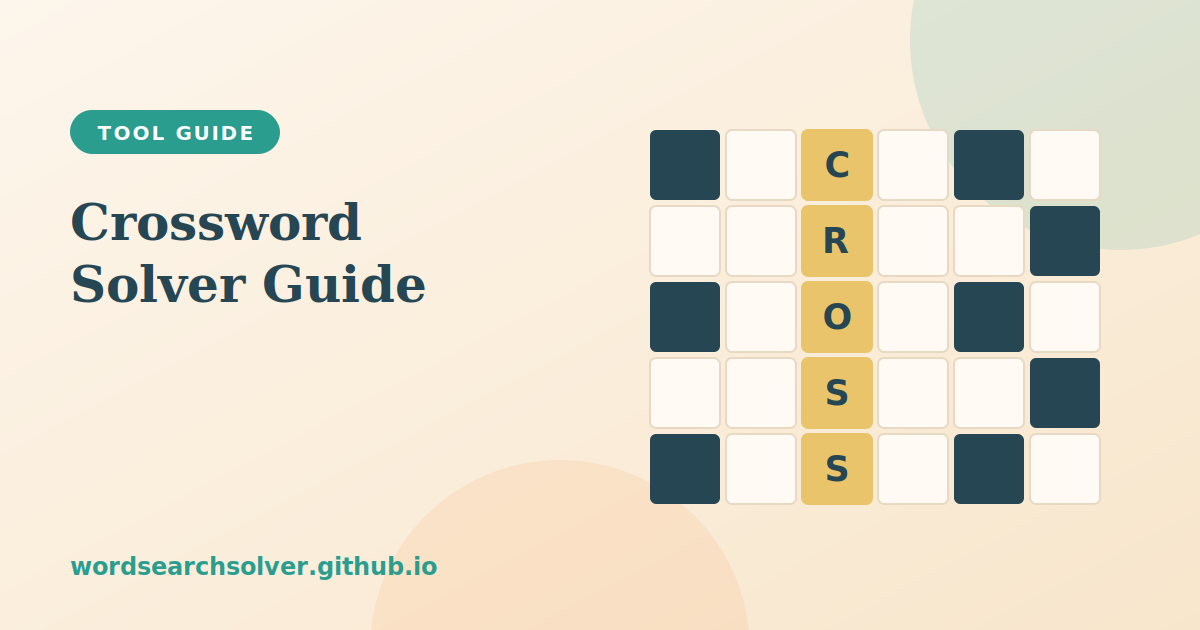
The Crossword Solver works from the one thing a crossword always gives you: the shape of the answer. You enter the letters you already have, mark the blanks and the tool lists every dictionary word that fits. This guide explains how to write patterns correctly, how to use the filters to narrow a long list, and how to build your own solving skills along the way.
How a Crossword Solver Works
Unlike a clue-based search, which tries to understand the wording of a clue, a pattern solver ignores the clue entirely. It looks only at the squares. If the answer has seven squares and the third square is an R, the solver finds every seven-letter word with an R in the third position. This sounds limited, but in practice it is the most reliable method, because crossing letters from other answers do most of the work for you.
Our tool checks your pattern against a dictionary of more than 60,000 words. Because the lookup runs locally in your browser, results appear in milliseconds with no waiting and no data sent anywhere.
The main advantage is that it never gets distracted by clever wordplay. Cryptic and cleverly worded clues can lead you astray for a long time, but a pattern with four known letters narrows the possibilities so sharply that the answer is often obvious the moment you see the list.
Pattern Symbols the Solver Understands
Describing a grid entry takes only three kinds of character, and you can mix them freely.
| Symbol | Meaning | Example |
|---|---|---|
| A letter (A to Z) | A square you have already filled in, in upper or lower case | C_T matches CAT, COT, CUT |
| ? (question mark) | Any single unknown letter | ?A?E matches CAKE, LAKE, MADE |
| _ (underscore) | Same as a question mark, whichever feels more natural | CRO__WORD matches CROSSWORD |
The length of your pattern is the length of the answer. If the crossword answer has nine squares, your pattern must have nine characters. That is the single most important rule, and the most common reason people see no results: a pattern that is one character too short or too long matches nothing.
Step-by-Step: Solving Your First Clue
- Count the squares in the answer you are stuck on.
- Open the Crossword Solver and type one character per square: the letter if you know it, a question mark or underscore if you do not.
- Optionally add filters (explained next) to reduce the list.
- Press the find button and read the matches.
- Compare each match with the clue. Even a weak match usually jumps out once you see it written down.
- Click a result to copy it, then check that it fits the crossing answers before writing it in.
That last check matters. A word that fits the pattern is only a candidate. Always test it against the crossing clues, because a wrong letter can mislead you for several more answers.
Using Must-Contain and Must-Exclude Filters
Sometimes a pattern is too loose. Entering ??????? returns thousands of seven-letter words, which is no help at all. The two optional filters turn a long list into a short one.
Must contain
Use this when you know a letter appears somewhere in the answer but not exactly where. If a crossing answer has given you a K but you are unsure which square it belongs to, add K to the must-contain box and the list shrinks to words that include it.
Must exclude
Use this to rule letters out. After you have eliminated several wrong guesses, or when a clue's wording rules out certain letters, add them to the exclude box. Excluding common letters such as E or S can reduce a list dramatically.
Crossword Strategies That Work Beside a Solver
Even with a solver, good habits make you faster and more accurate. These are the ones experienced solvers rely on.
- Start with the short, easy answers. Fill in the clues you are sure of first. Each one gives you crossing letters for the harder answers.
- Look for plural and past tense signals. A clue ending in a plural usually has an answer ending in S. A clue in the past tense usually ends in ED.
- Pay attention to abbreviations. If the clue includes an abbreviation or the word briefly, the answer is probably short or abbreviated too.
- Question marks in clues mean wordplay. A clue that ends in a question mark often hides a pun. Do not take it literally.
- Use the crossings, not just the clue. A confirmed letter is worth more than a clever guess.
- Leave and return. If you are stuck, move to another part of the grid. A fresh look often reveals what you missed.
Who Benefits From a Crossword Solver?
Crosswords appeal to a wide audience, and the solver fits several different habits.
- Daily solvers who want to keep a streak going without giving up on a single stubborn clue.
- Learners of English who use the tool to explore vocabulary, check spelling and see which words fit a given shape.
- Puzzle constructors who need to check which real words can fill a tricky intersection before finalising a grid.
- Older adults and caregivers who use crosswords as a gentle mental exercise and want a quick way to prepare or verify answers.
- Editors and proofreaders who need to confirm that a published answer is a valid dictionary word.
If you also enjoy letter-based puzzles, the Anagram Solver guide explains how to unscramble letters, which helps with the many crossword clues that hint at rearranged letters with words like mixed, confused or arranged.
What a Pattern Solver Cannot Do
A pattern solver is a precise tool, not a mind reader, and it is useful to understand its limits. It will not match multi-word answers unless you remove the spaces, because crossword grids do not print spaces. For example, a phrase answer such as ICE AGE should be entered as ICEAGE with six squares.
It also will not understand a clue's meaning. If your pattern has too few known letters, the list may contain hundreds of words. In that case, fill in more of the grid first, add a filter or return to the clue and look for hints about the type of word expected.
Finally, a dictionary can only contain words it knows. Very obscure names, brand names and slang may not appear. If you are certain of the pattern and see no valid match, the answer may be a proper noun or a newer term.
Frequently Asked Questions
How do I enter blank squares in the crossword solver?
Use a question mark or an underscore for every empty square. Both work in exactly the same way.
Why does my pattern return no results?
Check that the number of characters equals the number of squares in the answer and that you have removed spaces from phrase answers.
Can I search for words that contain a certain letter?
Yes. Add the letter to the must-contain filter to see only words that include it anywhere.
How big is the dictionary?
The solver matches against more than 60,000 words, so it covers most everyday crossword answers.
Is the crossword solver free?
Yes. It is free, requires no account and works on phones, tablets and desktops.